I study learning-based locomotion and perception for autonomous robots. My work spans humanoid and quadruped control, human motion retargeting, and autonomous navigation.
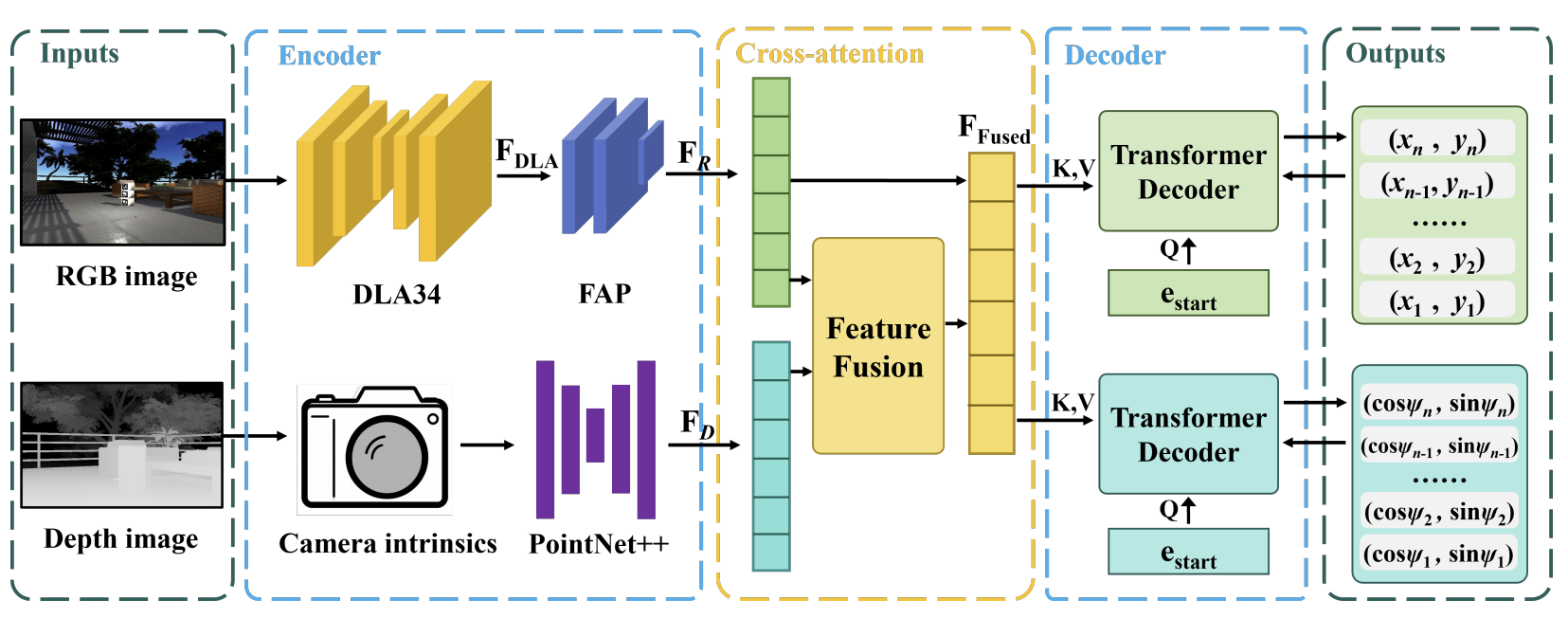
A closed-loop system for humanoid traversal through cluttered spaces, connecting scene perception, whole-body motion generation, and control. Learned from roughly 100 hours of human demonstrations, it coordinates ducking, stepping over obstacles, and local route selection using egocentric sensing and onboard inference.
Cluttered-space traversal
Real world · Traversing a confined course with blocks, overhead constraints, and low barriers.
A depth-guided locomotion framework for the Unitree G1, combining learned foothold estimation, recurrent terrain memory, and a mixture-of-experts policy to traverse stairs, gaps, and raised platforms.
Unitree G1
29 DoF
4 policy experts
50 Hz control
Outdoor stair ascentClimbing an outdoor staircase with depth-guided foot placement.
Hardware demonstrations
6 clips
Foothold visualization in simulation
Unitree G1 descending stairs in simulation, with foothold markers visualized on the terrain.
This clip could not be loaded. Please refresh the page and try again.
Method & implementation
Predictive perception. A mixture-density variational foothold estimator predicts contact locations, while an attention-based GRU retains local terrain geometry across depth frames.
Expert policy. Four softly gated experts are trained with PPO and terrain-conditioned adversarial motion priors. Walking style is distilled from a previously trained flat-ground policy.
Sim-to-real transfer. Calibrated depth-sensor models, firmware-informed actuator gain randomization, and compliance-oriented reward shaping address measured hardware mismatches.
Deployment. A shared sensor pipeline and a fused recurrent ONNX graph connect depth, IMU, and joint-encoder inputs to 29 joint-position targets at 50 Hz.
Current scope: real-robot demonstrations on structured terrain. The technical report identifies a remaining descent-energy gap between simulation and hardware; broader repeated-trial evaluation remains future work.
03
Video-to-robot motion imitation
May 2026 - Jun 2026
ViMoRe + MoTrace · Unitree G1
A connected workflow that reconstructs human motion from monocular video, retargets it to a 29-DoF humanoid, and trains a whole-body tracking policy in simulation.
Monocular video
SMPL-X motion
G1 reference
RL tracking
Tennis swingReconstruction & tracking
Human motion reconstructionVideo overlay & world-frame motion · GVHMR
This clip could not be loaded. Please refresh the page and try again.
This clip could not be loaded. Please refresh the page and try again.
Method & implementation
ViMoRe
Integrated GVHMR reconstruction with GMR retargeting to produce G1 joint-motion references. Validated tennis, basketball dance, and break-dance clips, with clip-start trimming to handle initial-pose inverse-kinematics traps.
MoTrace
Converted references into training data with quaternion validation and forward-kinematics replay. Adapted BeyondMimic workflows to local motion files for training, checkpoint evaluation, and ONNX export.
Demonstrated
Per-motion tracking policies for tennis and basketball dance in simulation. Motion reconstruction currently targets static-camera input videos.
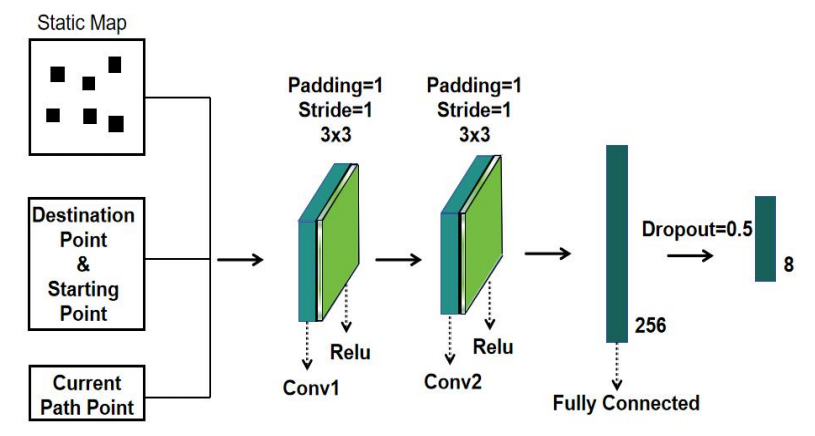
A mobile robot navigation stack for sequential goal search in a simulated factory, integrating 3D mapping, localization, target detection, and global–local planning.
End-to-end navigation in simulationFull multi-goal navigation workflow, with the Gazebo scene, camera observations, and RViz navigation view shown together.
This clip could not be loaded. Please refresh the page and try again.
Mapping
Built 3D point-cloud maps and 2D occupancy grids, with AMCL and EKF-based localization to reduce long-term pose drift.
Navigation
Combined YOLO target detection with A* / TEB planning and layered costmaps for autonomous search and navigation across multiple goals.
ROS
Gazebo
AMCL / EKF
A* / TEB
YOLO
05
Single-leg handstand for quadruped robots
Aug 2025 - Nov 2025
Unitree Go1 · MuJoCo / MJX · Brax PPO
Learning to balance a quadruped on a single front foot. A custom Go1 task combines support-foot balance and foot-lift rewards with two-stage PPO training to develop and refine the skill in simulation.
This clip could not be loaded. Please refresh the page and try again.
Method & implementation
Task design. Extended the two-leg handstand environment with center-of-mass alignment over the support foot, free-foot lift and contact rewards, and pose regularization for the non-supporting legs.
Two-stage training. Learned the skill with PPO, then fine-tuned with energy, joint-acceleration, and action-rate penalties alongside domain randomization.
Sim-to-sim validation. Exported policy weights and observation normalization for standalone MuJoCo playback at 50 Hz. The validation setup supports standing, two-leg handstand, single-leg handstand, and crouched initial poses.

 View figure